The following was copy-pasted and adapted from Limithron's Guide to Naval Combat to fit my own sensibilities and the design philosophy of Nimble.
Ship Statistics
Speed
The number of 50ft hexes the ship can move a turn with favorable winds. Also the maximum number of 15 mile spaces a ship can travel a day. See the section on “Wind and Movement,” and “Ship Speed” in Sailing.
Armor
Represents the resilience of the ship’s hull. Any armor ignores damage bonuses, while Heavy armor additionally grants resistance to rolled damage.
Hit Points and Formula
The amount of damage a ship can take before it is Derelict. This number is scaled down by a factor 1:5 when compared to creature-scale encounters. See the section on “Dice and Scaling.” HP per level is also given for upgrade purposes.
Temporary HP
This is HP gained while performing repairs in combat. When added to a ship’s current HP, the result can never exceed the ship’s maximum HP. Subsequent actions may add to Temporary HP. Temporary HP lasts no longer than 12 hours.
Damage
The amount of damage the ship does with its primary weapons (typically Broadsides, with Round Shot). The first range increment lists the maximum range before the ship takes Disadvantage 1 on its attack; the second lists the hard maximum range of the weapons.
Crew
The number of crew currently serving on the ship, and the maximum number the ship can accommodate. Crew numbers are not tracked for the purposes of ship combat but can be used for boarding and roleplaying.
Minimum Crew
The number needed to operate the ship without being Stressed. This is typically half of the ship’s maximum crew.
Captain
(NPC ships only) A notable figure captaining the ship. They typically include a static bonus to rolls made by the ship, and a damage bonus.
Abilities
Special abilities unique to each ship. The most common are Weatherly and Sluggish.
Cargo
The number of cargo "slots" the ship has, ranging from 0-10. Cargo might have different value in different ports. Also included are the default Food and Water stores (typically enough for 12 days), and Repair Supplies (typically enough for 6 repair actions). NPC ships also typically include a Lockbox entry, listing currency held aside from the ship’s cargo (typically in a literal loxbox in the Captain’s cabin).
Dice and Scaling
The dice rolls and statistics in this supplement are scaled by a factor of 1:5 when compared to creature scale combat. For example, a ship that has 10hp and deals 1d6 damage would have 50hp if attacked by a creature, and it would deal 1d6 x 5 damage. Any damage dealt to ships by creatures should be rounded down to the nearest 5, or you can track exact ship hit points by multiplying their base value by five. A fireball spell could hypothetically sink a rowboat or canoe in one shot, but a 1st Rate Ship of the Line could have 1,000hp!
Skill and Ability Test Difficulty
The default difficulty for skill and ability checks during ship combat is DC12. Checks are rolled by the acting Captain unless another character is at a corresponding Action Station. The GM can modify the DC based on conditions like rough seas, weather, surprise, terrain, or a crew that is inexperienced, wounded, or frightened.
Movement and Position
Ship combat is played on a hex grid where each hex represents 50ft from center to center. Most ships will take up 1 to 3 hexes. They should be orientated with the center of the ship on the center of a hex with the bow and stern crossing perpendicular edges. Generally, a ship’s bow will only face one of 6 different hex directions, though the GM may allow half-turns in certain instances like boarding or navigating terrain. All turns are 60 degree rotations (one hex face) from the center of the ship.
Moving a Ship
All ships, if they take no other move actions during a turn, moves 1 hex directly forward. They do not do so if they are In Irons or Anchored.
Ships that are In Irons may not take actions to move foward, but may still rotate by Coming About.
Ships that are Anchored cannot move or turn.
Wind and Movement
The wind direction is an important part of sailing. In combat, the wind blows in the same direction as during the same watch; see “Wind” on the Sailing page.
If the GM needs to randomly determine wind direction at any point, they may roll a d6:
| d6 | Wind Direction |
|---|---|
| 1 | North |
| 2 | Northeast |
| 3 | Southeast |
| 4 | South |
| 5 | Southwest |
| 6 | Northwest |
Points of Sail
Ship sailing speeds depend on the angle of the wind. A ship's point of sail is determined at the start of its turn and does not change during its turn. If a ship starts its turn With the Wind and then turns Close to the Wind, it still gets its full movement that turn.
Note that Weatherly ships sail Full Speed even when Close to the Wind in combat.
| Point of Sail | Ship Speed |
|---|---|
| With the wind | Full speed |
| Close to the wind | Half speed rounded up (min. 1 hex) |
| In Irons | Speed 0 (can turn with Come About) |
Example: If the wind is coming from 1 (North), and the ship faces the same way, this ship is In Irons and cannot move (but may still turn with Come About). If the wind is coming from 2 or 6, it is sailing Close to the Wind and may only move half of its normal speed; at 3, 4, and 5 it would be With the Wind and can move its full movement.
Combat Rounds
Like creature combat, ship combat is organized into turns and rounds. Initiative is rolled for each ship, and the creatures on that ship all act on their ship’s turn. Independent creatures, like sea monsters or characters not on a ship, roll their own initiative.
Sailing is slow, and weapons take time to reload, but these rules are designed to be fast and fun. For the purposes of rules and action economy, a round of combat represents 6 seconds in the game world, though 30 seconds to 1 minute is a more thematic representation.
Combat Round Step by Step
- Captain Phase. Captains choose their ship’s actions, and they may roll to Push the Crew.
- Initiative. Declare any Lookouts. Lookouts (or Captains) roll initiative.
- Take turns. Each ship takes a turn in initiative order. On a ship’s turn, characters may go in any order they see fit. Each may choose an Action Station based on the Captains chosen actions, and they may choose a different station each turn. They may also choose another action like casting a spell. Ships and characters may Ready actions to trigger anytime before the ship’s next turn.
- Begin the next round. Repeat the steps until the combat is over.
Captain’s Phase
During this phase, each ship’s Captain decides what actions the ship will take. Each ship has 3 Action Points per turn, and the Captain can spend any of these to assign actions for the characters and crew on board to carry out. Any actions not carried out by the other characters will be rolled by the Captain.
Each ship must have an assigned Captain. If none of the characters are currently the Captain of a ship they are on board, it is recommended that the GM assign an acting Captain.
A Captain may Push the Crew during this phase of the turn.
Push the Crew (no cost). Roll a DC 12 Influence check. On a success, the ship gains one extra action point this turn. The ship loses one action point on its next turn unless the captain rolled a 22+/critical result. A Captain cannot Push the Crew if they succeeded in doing so the previous round.
Initiative Phase
Initiative is rerolled each round of combat. After all Captains have decided their ships’ actions for the turn, each ship rolls a d20 and adds its captain’s KEY stat. This roll may alternatively be made by the ship’s declared Lookout using their Perception or Insight skill (see Lookout, below).
Character Actions
Here character actions in combat are summarized.
| Action | Skill | Cost | Effect (DC 12) | Crit (DC 22 / nat 20) | Action Station |
|---|---|---|---|---|---|
| Push the Crew | Influence | -(1/two turns) | Gain 1 action point; lose 1 action point next turn. | Gain 1 action point. | Captain |
| Raise Morale | Influence | -(1/turn) | +1 to all skill checks and damage rolls this turn; or remove Stressed for 1 turn. (+2 or 2 turns on DC 17) | +3 to all skill checks and damage rolls this turn; or remove Stressed for 3 turns. | Bosun |
| Sail (move) | - | 1(1/turn) | Move full speed (as determined by wind direction). Cannot be Anchored. | - | Pilot |
| Come About | Might / Finesse | 1 | Rotate by 1 (2 if Weatherly). | Rotate by 2 (3 if Weatherly). | Pilot |
| Ram (move) | - | 3 | Move; ram if bow touches another ship. Roll primary attack die plus 1/2 hexes traveled this turn. | - | Pilot |
| Attack (Broadside) | - | 1(1/turn per side) | Attack with primary attack. Cannons reload at start of turn. (Firing both sides costs 2 action points total) | As normal for critical damage (same as Nimble) | Gunner |
| Attack (Fore/Aft) | - | 2 | Attack with secondary attack: roll one die rank lower (ie. d4 instead of d6, d6 instead of d8, etc.) | As normal for critical damage (same as Nimble) | Gunner |
| Take Aim | Perception / Finesse | -(1/turn) | Grant 1/2 level bonus or Advantage 1 to attack rolls this turn. | Grant level bonus or Advantage 2 to attack rolls this turn. | Gunner |
| Initiative | Perception / Insight | - | Roll initiative for the ship | - | Lookout |
| Brace | Perception / Insight | (reaction, 1/round) | (DC 17) Increase the ship’s armor by 1 tier against an attack | Increase the ship’s armor by 2 tiers instead. | Lookout |
| Repair | Examination / Might | 2 | Gain Temp HP = half of maximum primary attack damage*; or remove Derelict. | Gain Temp HP equal to full maximum*; or remove Derelict and gain 1d4+KEY HP. | Carpenter |
| Full Sail (move) | Influence / Finesse | 2 | Move full speed. Cannot be Anchored. | Move full speed +2 hexes. Cannot be Anchored. | Rigger |
| Drop Anchor | - | 3 | Become Anchored. | - | - |
| Weigh Anchor | - | 3 | No longer Anchored. May move 1/2 speed (rounded up). | - | - |
| Cut and Run | - | 1 | May move 1/2 speed (rounded up), is no longer Anchored, but loses its anchor. | - | - |
| Change Ammo Type | - | -(1/turn) | Change ammo (round shot, chain shot, grape shot, etc.) | - | - |
* A ship’s temporary HP added to its current HP can never exceed its max HP. Subsequent Repair actions can add to a ship’s current temporary HP. Temporary HP lasts no longer than 12 hours.
Action Stations
Each turn, a character may claim one of the available Action Stations detailed below. All are optional and can be re-chosen each round. Any actions that are not covered by a PC are rolled for by the Captain using the their own Influence skill, though only the basic (DC 12) success for each action can be achieved this way.
Other than the Captain, all stations are optional.
Captain
(see Captain’s Phase, above)
Bosun
Raise Morale (no cost). Make a DC 12 Influence skill check. On a success, choose one of the following:
- give all of the ship’s attacks and skill check rolls +1 this turn (+2 on a 17-21, or +3 on a 22+); or
- temporarily remove the Stressed condition from the ship for one turn (two turns on a 17-21, or three on 22+).
Pilot
Sail (Move, 1 action, 1/turn). Move the ship its full speed, as determined by the wind’s direction.
Come About (1 action). Make a DC12 Might or Finesse roll. On a success, you may rotate the ship by 1 hex face, or 2 if the ship is Weatherly. On a 22+/critical result, you may instead rotate the ship by 2 hex faces, or 3 if Weatherly.
Ram (Move, 3 actions). Move the ship its full speed, as determined by the wind’s direction. If the ship’s bow touches another ship at the end of this move, deal the ship’s primary attack damage. Add a damage bonus equal to half the number of hexes moved during this turn, rounded up.
Gunner
Take Aim (no cost, 1/turn). Make a DC 12 Finesse or Perception check. On a success, grant the ship one of the following:
- Advantage 1 on all ship attack(s) this turn (or Advantage 2 on a 22+/critical result); or,
- A damage bonus on ship attacks(s) this turn equal to 1/2 you character level, rounded up (or your full character level on a 22+/critical result).
(Note that medium and heavy armor ignores damage bonuses in Nimble, including the bonus granted by option 2)
Arc of Fire
In the age of gunpowder weapons, most ships carried the majority of their arsenal along the side of the ship, requiring the vessel to maneuver to the sides for most cannons to have a shot.
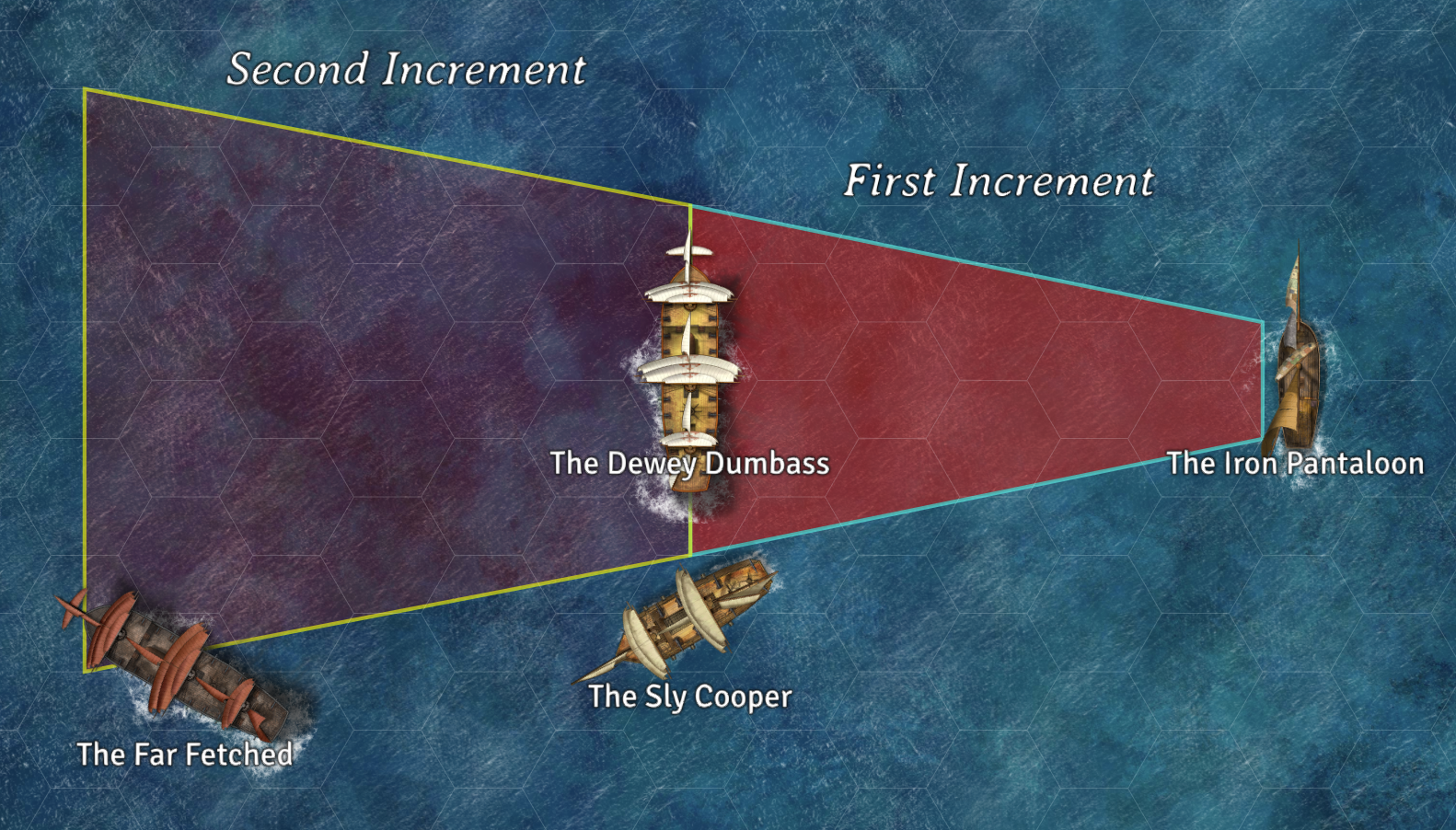
Broadside refers to this area. A Broadside attack may hit a ship directly in line perpendicular to the ship’s movement at the first range increment, or one adjacent hex fore or aft. If a ship attempts an attack at the second range increment, they may hit an arc from two spaces fore or aft.
Example The Iron Pantaloon, below, has a standard range increment of 6/12. It may fire its Broadside cannons at the Dewey Dumbass, rolling its attack as normal. It may not, however, fire upon the Sly Cooper. It may instead choose to fire upon the Far Fetched, but it will take Disadvantage 1 on its attack.
Other attacks can only fire Fore & Aft. Ships do not have these attacks by default unless specified in their stat block. Typically these attacks deal 1 die rank lower than its primary attack (so a ship which deals 1d8 primary damage would deal 1d6 damage with its chase guns; a ship dealing 2d6 damage would deal 2d4).
Lookout
Initiative. The Lookout rolls initiative for the ship using their own Perception or Insight skill, and they may choose to swap turns with one ship going directly after their own in initiative. (Ship initiative otherwise works identically to 5e, not Nimble).
Brace (reaction, 1/round). The Lookout may roll a DC 17 Perception or Insight to brace the ship in response to one single attack. On a success, they increase the ship’s armor by one tier against that attack. On a 22+/critical result, they instead increase it by 2 tiers, and may negate damage entirely.
For reference, armor tiers are as follows.
- No armor, taking full damage;
- Medium armor, taking only rolled damage;
- Heavy armor, taking half of rolled damage;
- No damage, available on a 22+/critical result.
Carpenter
Combat Repair (2 actions) Roll a DC 12 Examination or Might check. On a success, grant temporary HP equal to half of the ship’s maximum primary damage die. On a 22+/critical result, instead grant the ship temporary HP equal to its maximum primary damage die. (Half of 1d8 is 4; half of 2d6 is 6)
Derelict Repair (2 actions) If the ship is Derelict, you may instead grant the ship 1 HP on a successful check (thereby removing the Derelict condition). On a 22+/critical result, you grant the ship 1d6+KEY HP instead.
As a reminder, the Derelict condition imposes Disadvantage 1 on Repair checks.
Rigger
Full Sail (Move, 2 actions) Roll a DC 12 Influence or Finesse check. On a success, the ship moves full speed in its current direction. On a 22+/critical result, the ship moves full speed +2 hexes in its current direction instead.
Note that Full Sail typically accompanies a standard Sail action, doubling the amount of movement a ship may travel in a turn.
Other Actions
Characters not taking an Action Station may take any individual actions like casting a spell, attacking another creature, swinging from the rigging, diving from a ship, achieving enlightenment, etc.
One particularly useful spell a character may cast during combat is included here.
Command the Wind Wind Cantrip, 3 actions
A character of the specified level who has access to the Wind spell list may spend mana to influence the winds in the following ways on their turn:Wind changed in this way may be further changed and maintained with concentration over multiple turns. If multiple creatures are attempting to influence the wind in the same area, they roll opposed KEY checks on each turn to gain or maintain control of the winds. Dropping concentration on this spell immediately reverts the wind to its natural direction.
- 2 mana (Level 2) Change the wind direction by 1 hex face for their ship only.
- 4 mana (Level 7) Change the wind direction by 1 hex face for an enemy ship within 10 hexes.
- 10 mana (Level 12) Change the wind direction by 1 hex face for the entire battlefield. (Level 17) You may exempt a number of ships on the battlefield from this change equal to your KEY stat.
For example, on a naval battlemap with flat-top hexes, the wind is currently blowing due North. If a wind magic-user spends 4 mana to change the wind from North to Southwest on turn 1 for their own ship, they may subsequently concentrate on this ability on turn 2 and choose to: maintain the wind in that direction; change the wind direction back to North; or change the wind direction to the Southeast.
Conditions and Abilities
In Irons
A ship is In Irons if its bow is facing directly against the wind. It may not take any Move actions.
Anchored
A ship that is Anchored does not move during its turn. It may not take any Move actions. The following actions add or remove the Anchored condition.
Drop Anchor (3 actions) Add the Anchored condition to the ship.
Weigh Anchor (3 actions) Remove the Anchored condition from the ship and move it up to half its speed, rounded up.
Cut and Run (1 action) Remove the Anchored condition from the ship and move it up to half its speed, rounded up. The ship loses its ability to Drop Anchor until it replaces its anchor.
Stressed
A ship is Stressed when it has less than half of its starting hit points. A ship is also Stressed if it has less than its listed minimum crew. A Stressed ship imposes Disadvantage 1 on all its attacks and skill checks.
The Bosun can take the Raise Morale action to attempt to temporarily remove this condition in combat.
Derelict
A ship is Derelict when it has 0 hit points. Its speed is 0, and it may only spend its Action Points in combat on the Repair action.
Drifting. The GM may choose to have a Derelict ship drift one hex each turn depending on weather conditions.
Sinking. Every time a Derelict ship takes additional damage, it must make a sinking saving throw. Roll a d20. If the roll is 10 or higher, the ship does not sink. Otherwise it fails and the ship sinks into the water. If a Derelict ship is hit with a critical hit, it immediately fails its sinking saving throw.
Repairing. The only action a Derelict ship may take is Repair, which is made at Disadvantage 1. The Carpenter may choose to gain Temporary HP as normal; or regain HP and remove Derelict.
Weatherly
A Weatherly ship (typically Cutters or similarly small craft) is far more maneuverable than larger ships. It does not decrease its max speed when sailing Close to the Wind in combat. It also may rotate one additional hex face when it Comes About.
This ability does not affect ship speed outside of combat.
Sluggish
A Sluggish ship (typically large Galleons or Brigs) can only rotate once per turn in combat.
Ammunition
Ships typically carry round shot (cannon balls) by default, but other types of ammo may be purchased from shipwrights. Additional ammunition ideas: canister shot, heated shot, spider shot, smoke bombs, poisonous canisters, random cargo (fork and knives), cursed bones, and magical ammo.
Round Shot Round shot, or simply "cannon balls", are accurate and deadly at long range. They can cause massive damage against their targets and are used in all types of naval warfare, especially when the primary objective is sinking the enemy.Range. 6/12
Chain Shot Chain shot is made by attaching two cannonballs—or two halves of a single cannonball—together with a chain. It is designed to attack a ship's masts and rigging and is typically used to slow ships down.Range. 3/6 Target Masts & Rigging. Attacks made with Chain Shot deal half damage, rounded up. Any ship that has taken damage from Chain Shot moves at half speed (rounded up) until the end of its next turn. Critical Hit. When a Chain Shot attack scores a critical hit, the target ship’s speed is reduced to 0 until the end of its next turn.
Grape Shot Grapeshot is made by filling a bag or hollow ball with small round metal balls, similar to shotgun shells. It is very effective against creatures but less so against a ship's hull.Range. 3/6 Target Crew. Attacks made with Grapeshot deal half damage rounded up. Any ship that has taken damage from Grape Shot gains Disadvantage 1 on Skill checks and loses 1 action point until the end of its next turn. Critical Hit. When a Grapeshot attack scores a critical hit, the target ship can only spend 1 Action Point on its next turn (and all skill checks suffer Disadvantage 1).
Naval Combat